

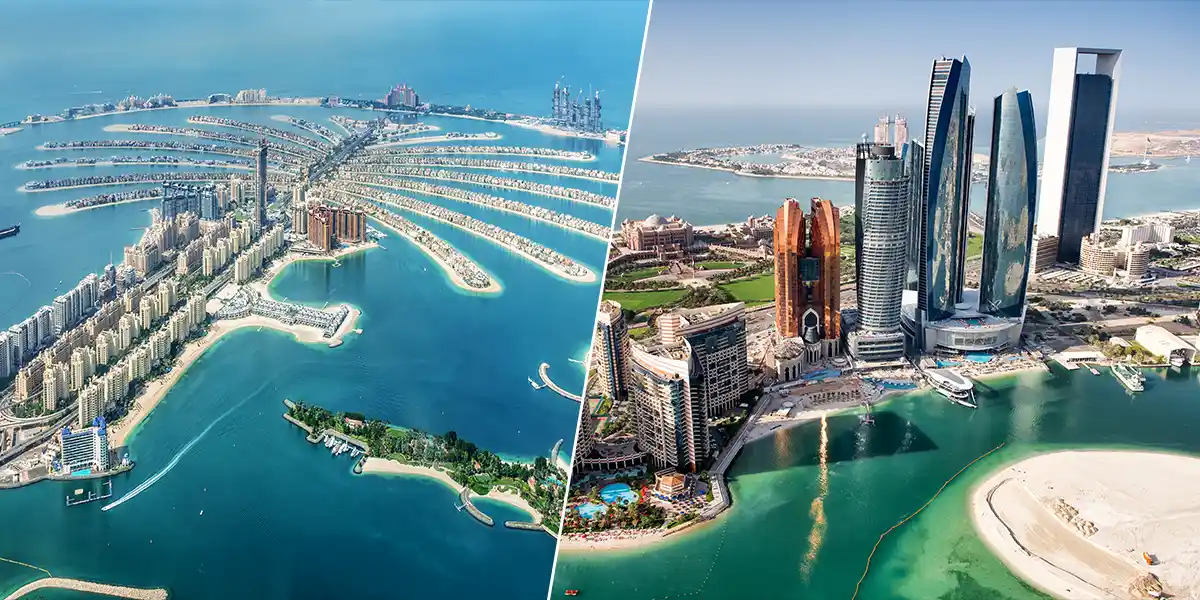
Dubai and Abu Dhabi are often compared, but seasoned investors understand that the two emirates represent two distinct opportunities. While Dubai is known for its fast-moving, internationally recognised real estate market, Abu Dhabi has built a reputation for long-term stability, carefully planned communities, and steady capital appreciation. Choosing between the two depends less on which market is "better" and more on your investment objectives, budget, and lifestyle priorities.
If you’re weighing Dubai vs Abu Dhabi, read on to compare real estate opportunities, property investment potential, ownership regulations and the cost of living in both emirates.
Key Takeaways
Dubai and Abu Dhabi are two of the UAE's most desirable destinations for living and property investment, but each offers distinct advantages depending on your priorities.
Dubai has a larger and more internationally active real estate market, with a wider range of investment opportunities, property types and established communities.
Abu Dhabi is known for its master-planned neighbourhoods, family-friendly lifestyle and steadily growing property market.
A cash buyer in Dubai should budget roughly 6% to 7% above the purchase price, against roughly 3% to 4% in Abu Dhabi.
Apartment rents in the two capitals are closer than most buyers assume. The real cost of living gap shows up in villas, family space and government fees.
Both emirates allow foreign nationals to purchase property in designated freehold areas, creating opportunities for investors and owner-occupiers alike.
Choosing between Dubai and Abu Dhabi ultimately depends on your investment strategy, preferred lifestyle and long-term financial goals.
Dubai vs Abu Dhabi at a Glance
Category | Dubai | Abu Dhabi |
Overall Appeal | Fast-paced, cosmopolitan and globally connected | Relaxed, spacious and family-oriented |
Population | 4.47 Million | 4.1 Million |
Property Market | Larger, more established and highly liquid | Growing, stable and increasingly attractive to international buyers |
Average Price per Sq Ft | Approximately AED 1,700 to AED 1,950 | Approximately AED 1,500 for ready homes, higher for off-plan |
Buyer Transaction Costs | Approximately 6% to 7% for a cash buyer | Approximately 3% to 4% for a cash buyer |
Government Property Transfer Fee | 4% of the purchase price | 2% of the property's sale price or market value |
Gross Rental Yields | 5.5% to 7% | 5% to 8% |
Rent Increase Rules | Sliding scale of 0% to 20% under the RERA Smart Rental Index | Temporarily capped to 0% |
Municipality Housing Fee | 5% of annual rent | 3% of annual rent |
Public Transport | Metro, tram, buses and water transport | Bus network, with a metro under development |
Best Suited For | Investors seeking liquidity, professionals, entrepreneurs and buyers wanting the widest choice of communities | Families, long-term residents and buyers prioritising space, stability and community living |
Dubai vs Abu Dhabi Real Estate
Real estate is often the deciding factor when comparing Dubai vs Abu Dhabi. Both emirates have established themselves as attractive destinations for local and international buyers, but their property markets have developed at different speeds and cater to different investment strategies.
Dubai is widely recognised as one of the world's most active real estate markets, attracting investors from across Europe, Asia, the Middle East and beyond. Abu Dhabi has built its reputation through carefully planned communities, steady market expansion and long-term investment potential.
For buyers and investors, the key differences include:
Market maturity: Dubai has a larger, more established property market, while Abu Dhabi continues to expand with new freehold communities.
Investment strategy: Dubai often appeals to investors seeking liquidity and capital growth, whereas Abu Dhabi attracts buyers focused on stability and long-term ownership.
Property choice: Both cities offer apartments and villas, although Dubai provides a broader range of branded residences, mixed-use developments and luxury waterfront projects.
Buyer profile: Dubai attracts a diverse international investor base, while Abu Dhabi has traditionally been driven by end-users, long-term residents and institutional investment.
Understanding these differences will help you choose the market that best aligns with your financial goals.
Market Maturity and Scale
One of the biggest distinctions in Abu Dhabi vs Dubai real estate is the maturity of each market.
Dubai's residential sector has evolved into one of the world's most internationally recognised property markets. Decades of continuous development have created an extensive selection of communities catering to every budget and lifestyle, while a high volume of transactions supports strong market liquidity. Sales volumes now run into the hundreds of thousands of transactions a year, which is what gives sellers realistic exit timelines.
Abu Dhabi's market is smaller but has grown steadily through carefully planned expansion. ADREC recorded AED 142 billion in total real estate transactions across the emirate in 2025, with residential sales reaching AED 76 billion. Increasing freehold opportunities and continued investment in residential communities have strengthened its appeal to local and overseas buyers.
Dubai is often chosen for:
A larger selection of residential communitiesHigher market liquidity and resale activity
Greater variety of developers and property types
Strong international buyer demand
Abu Dhabi is often chosen for:
Sustainable, long-term market growth
Master-planned residential communities
Lower-density neighbourhoods
A more measured investment environment
Property Types and Residential Communities
Both emirates offer a wide variety of residential property, although their development philosophies differ.
Dubai offers:
Luxury apartments
Family villas
Townhouses
Branded residences
Waterfront developments
Golf-course communities
Mixed-use neighbourhoods
This variety allows investors to target a broad range of tenant profiles, from young professionals and holidaymakers to families and high-net-worth individuals.
Abu Dhabi focuses more heavily on integrated communities designed for long-term living. Popular property types include:
Waterfront apartments
Spacious villas
Townhouses
Family-oriented residential compounds
Mixed-use developments

Freehold Ownership in Dubai and Abu Dhabi
Both Dubai and Abu Dhabi allow foreign nationals to purchase property within designated areas, but the legal routes differ. Dubai opened freehold ownership to foreign buyers under Law No. 7 of 2006, with eligible communities set out in a designated list. Provident maintains a full breakdown of the current freehold areas in Dubai.
Abu Dhabi moved later. Law No. 13 of 2019 amended Law No. 19 of 2005 on Real Estate Ownership, and from 16 April 2019 foreign individuals and companies owned wholly or partly by them have been able to hold freehold title to land within the emirate's designated investment areas. Before that change, foreign investors were limited to leasehold arrangements of up to 99 years.
Abu Dhabi's investment zones commonly include:
Saadiyat Island
Yas Island
Al Reem Island
Al Maryah Island
Al Raha Beach
Al Reef
Masdar City
Al Ghadeer
Hudayriyat Island
Lulu Island
Alongside freehold, Abu Dhabi also recognises usufruct rights of up to 99 years and musataha surface rights of up to 50 years, both renewable. Confirming which title a project carries is an essential due diligence step.
Before purchasing in either emirate, buyers should consider:
Ownership eligibility and title type
Developer reputation and delivery record
Community regulations
Service charges
Future infrastructure plans
Long-term resale potential
Neither emirate levies annual property tax, capital gains tax or personal income tax on rental earnings. Property investment of AED 2 million or more also opens the route to a 10-year renewable Golden Visa in both.
Property Prices: Dubai vs Abu Dhabi
Property prices vary depending on location, developer, property type and amenities. The figures below are indicative ranges rather than fixed rates.
Dubai:
Citywide average of roughly AED 1,700 to AED 1,950 per sq. ft.
Downtown Dubai around AED 3,000 per sq. ft.
Business Bay around AED 2,550 per sq. ft.
Dubai Marina around AED 2,060 per sq. ft.
Mid-market communities such as JVC sit well below the citywide average
Abu Dhabi:
Ready homes averaging around AED 1,507 per sq. ft. and off-plan around AED 2,191 per sq. ft.
Al Reem Island from roughly AED 900 to AED 1,400 per sq. ft., the most accessible of the major investment zones
Yas Island apartments from roughly AED 1,200 to AED 1,800 per sq. ft.
Saadiyat Island apartments from roughly AED 1,800 to AED 2,800 per sq. ft., with prime stock trading higher
The pattern is consistent. Prime waterfront pricing in Abu Dhabi now rivals prime Dubai, while mid-market and villa stock remains meaningfully cheaper per square foot. Rather than focusing solely on price per square foot, buyers should also assess future infrastructure, planned developments, community facilities and long-term demand.
Cost of Buying a Property in Abu Dhabi vs Dubai: Fees and Transaction Costs
This is where the two markets diverge most sharply, and it is often overlooked.
Cost | Dubai | Abu Dhabi |
Government transfer fee | 4% of the purchase price | 2% of the purchase price |
Registration or trustee fee | AED 2,000 plus VAT below AED 500,000, or AED 4,000 plus VAT above | AED 1,000 to AED 4,000 |
Title deed issuance | AED 580 | Included in the registration process |
Agency commission | 2% | 2% |
Mortgage registration | 0.25% of the loan amount plus an AED 290 admin fee | 0.1% of the loan amount, minimum AED 500 and capped at AED 1,000 |
Total for a cash buyer | Approximately 6% to 7% above the purchase price | Approximately 3% to 4% above the purchase price |
Cost of Living in Dubai vs Abu Dhabi
When comparing the cost of living in Dubai vs Abu Dhabi, remember that expenses vary depending on lifestyle, family size and the community you choose. Both cities offer a high standard of living, and Dubai is generally the more expensive of the two, particularly in prime residential areas.
The gap is narrower than the reputation suggests. On a like-for-like apartment, the two cities are close. Abu Dhabi's advantage sits in villa rents, government fees and utility structure, which is why the difference compounds most for families rather than single professionals.
Housing Costs
Housing remains the biggest factor when comparing Abu Dhabi vs Dubai cost of living.
Indicative annual apartment rents in Dubai:
One-bedroom in Jumeirah Village Circle from around AED 70,000 to AED 75,000
One-bedroom in Business Bay from around AED 90,000 to AED 100,000
One-bedroom in Dubai Marina from around AED 100,000 to AED 110,000
A citywide one-bedroom average of roughly AED 80,000, with a realistic range of AED 38,000 to AED 168,000 depending on community
Indicative annual apartment rents in Abu Dhabi, using ADREC's official index as a benchmark:
Two-bedroom on Saadiyat Island around AED 138,600
Two-bedroom on Al Reem Island around AED 59,500
Two-bedroom in Mohamed Bin Zayed City around AED 33,200
Entry-level one-bedroom on Saadiyat Island from around AED 85,000 to AED 105,000, with furnished units adding a further 15% to 20%
A prime Abu Dhabi address costs as much as a prime Dubai one. Abu Dhabi's inland and mainland districts have no real Dubai equivalent at that price, which is where family budgets stretch furthest.
When evaluating housing costs, consider more than the purchase price or rent. Service charges, maintenance, parking and community fees all belong in the same calculation. Provident's renting guide and buying guide set out the full picture for Dubai.
Utilities and Household Expenses
Utility costs are broadly comparable, but the tariff structures differ in a way that matters for larger homes.
Dubai:
Residential electricity on a four-slab tariff from 23 to 38 fils per kWh
A monthly fuel surcharge set by DEWA, alongside a Dubai Municipality sewerage fee
A housing fee of 5% of the property's annual Ejari rental value, collected monthly through DEWA
Security deposits of around AED 2,000 for an apartment and AED 4,000 for a villa
Abu Dhabi:
A flat expatriate rate of 26.8 fils per kWh within the green band, rising beyond it
No separate fuel surcharge, unlike DEWA's 6 fils per kWh
A municipality housing fee of 3% of annual rent under Abu Dhabi Council Resolution No. 13 of 2016
A monthly meter service charge of AED 7.84 for expatriate residents
5% VAT applies to utilities in both emirates. On an AED 100,000 annual rent, the housing fee alone is AED 5,000 in Dubai against AED 3,000 in Abu Dhabi.
The biggest single variable is air conditioning. Abu Dhabi's flatter band structure works out cheaper for high-consumption villas, where Dubai's progressive slabs push consumption into the 32 to 38 fils bracket.
Groceries and Everyday Spending
Daily shopping costs are close to identical across the two emirates. Residents in both have access to international supermarket chains, local grocery stores, fresh food markets and premium imported products.
Your grocery bill depends more on shopping habits than location. Imported goods and speciality products cost more than locally sourced alternatives in both cities. Fuel is priced nationally by the UAE Ministry of Energy and Infrastructure, so petrol costs the same in Abu Dhabi as it does in Dubai.
Transport Costs
This is where Dubai's commuter costs run ahead.
Dubai:
Salik road tolls of AED 4 or AED 6 per gate crossing depending on time of day
A commuter passing two gates in each direction can expect roughly AED 350 a month in tolls
Metro fares on a Silver Nol card of AED 3 within one zone, AED 5 across adjacent zones and AED 7.50 across two or more zones, with a daily cap of AED 19
Abu Dhabi:
Darb tolls of AED 4 per crossing, charged only during weekday peak hours at bridges leading onto Abu Dhabi island
No operational metro at present, with public transport running on buses using the Hafilat card and an unlimited monthly bus pass at around AED 100
Abu Dhabi's tolls apply in narrower windows and its bus network is cheaper, but the absence of a metro means most residents rely on private vehicles. Dubai costs more per journey and gives you the option not to drive at all.
Education Costs
School fees are frequently the single largest line in a family budget, ahead of rent.
Dubai fees run from around AED 9,000 a year at budget Indian-curriculum schools to AED 110,000 and above at top-rated IB and British schools
KHDA caps annual increases through the Education Cost Index, set at 2.35% for the 2025 to 2026 academic year
Abu Dhabi averages sit slightly below Dubai for comparable schools, with ADEK applying equivalent fee regulation and annual approval processes
Budget for extras beyond tuition. Registration, transport, uniforms, books and examination fees typically add a further 10% to 20%.
Lifestyle: Living in Dubai vs Abu Dhabi
While real estate often drives the initial comparison between Dubai vs Abu Dhabi, lifestyle determines whether a city feels like home. Both emirates offer excellent infrastructure, high living standards and modern amenities, but the day-to-day experience differs.
Dubai is associated with a fast-paced, cosmopolitan lifestyle. Abu Dhabi offers a calmer, more residential environment. Neither is objectively better. They cater to different preferences and stages of life.
Pace of Life
One of the first differences many residents notice is the pace of everyday life.
Dubai is energetic and constantly evolving. New restaurants, attractions, developments and business opportunities emerge regularly, creating an environment that appeals to professionals, entrepreneurs and people who enjoy an active social calendar.
Abu Dhabi moves at a more measured pace. Although it has a thriving business community and growing entertainment scene, the atmosphere is generally quieter, making it particularly attractive to families and those seeking a better work-life balance.
Dubai
A vibrant city atmosphere
Networking and business opportunities
Frequent events and entertainment
A wide variety of dining and nightlife
Living in a highly international environment
Abu Dhabi
A slower pace of life
Less congestion in residential areas
Larger open spaces
A quieter community feel
A more relaxed daily routine
Dining, Shopping and Entertainment
Dubai is widely regarded as one of the world's leading lifestyle destinations. Residents have access to:
Michelin-recognised restaurants
International shopping malls
Luxury retail brands
Beach clubs
Concerts and live events
Theme parks
Rooftop dining
Year-round entertainment
Abu Dhabi also offers an excellent lifestyle, although its focus differs. Popular attractions include:
Cultural landmarks
Museums
Waterfront promenades
Family entertainment
Nature reserves
Golf courses
Beaches
Marina districts
Rather than competing directly with Dubai's scale, Abu Dhabi provides a more balanced lifestyle centred around culture, outdoor recreation and family activities.
Beaches and Outdoor Living
One advantage shared by both cities is year-round access to beaches and outdoor leisure.
Dubai is home to an extensive coastline featuring public beaches, luxury beach clubs, marinas and waterfront communities. Residents can enjoy everything from watersports and yacht clubs to beachfront dining and jogging tracks.
Abu Dhabi places greater emphasis on natural landscapes and open spaces. Its beaches, mangroves, islands and waterfront parks offer opportunities for kayaking, cycling, walking and other outdoor activities within a quieter setting.
Outdoor lifestyle highlights include:
Dubai:
Beachfront communities
Marinas
Water sports
Desert adventures
Golf courses
Cycling tracks
Abu Dhabi:
Natural beaches
Mangrove parks
Island escapes
Waterfront promenades
Family parks
Nature-based recreation
Education and Healthcare
Both emirates offer excellent education and healthcare systems, making them attractive destinations for long-term residents. Families can choose from a wide selection of private schools offering internationally recognised curricula, including British, American and International Baccalaureate (IB) programmes.
Healthcare standards are equally high, with modern hospitals, specialist medical centres and internationally accredited healthcare providers available throughout both cities.
When choosing where to live, many buyers prioritise proximity to schools and healthcare facilities alongside their property search.
Connectivity and Transport
Dubai benefits from one of the region's most developed public transport networks, including the Metro, tram, buses and water transport. Dubai International Airport and the emirate's road infrastructure make regional and international travel convenient.
Abu Dhabi relies more heavily on road transport, although continued investment has improved connectivity across the emirate. Well-maintained highways make travelling between residential communities and business districts straightforward, and Zayed International Airport serves the capital. An Abu Dhabi metro is in development, and Etihad Rail's passenger network is set to connect the two emirates directly.
The drive between the two cities takes roughly 90 minutes to two hours depending on traffic, which makes cross-emirate commuting possible but demanding as a daily routine.
Dubai or Abu Dhabi: Which Should You Choose?
Choose Dubai if you want:
Maximum liquidity and a fast resale market
The widest choice of communities and price points
The highest apartment yields and short-term letting potential
A metro-connected commute and a dense lifestyle offer
Choose Abu Dhabi if you want:
Lower transaction costs on entry
More space per dirham, particularly in villas
Predictable rent increases under a fixed cap
A quieter, family-oriented environment with tighter supply discipline